

Democrats won control of both the House of Representatives and the Senate in the Nov. 3 midterm elections, one of the most lopsided midterm results in modern times. When the new Congress is sworn in this January, President Trump will face Democratic majorities in both chambers for the final two years of his term.
The Senate turned on a string of upsets. Democrats flipped seven Republican-held seats: Kansas, Iowa, Texas, Ohio, Maine, North Carolina and South Carolina. By Nov. 5 they held 54 seats to the Republicans’ 44, with two races still counting. In Mississippi, Democrat Scott Colom led Sen. Cindy Hyde-Smith by about 1,700 votes. In Alaska, Democrat Mary Peltola led Sen. Dan Sullivan by fewer than 700.
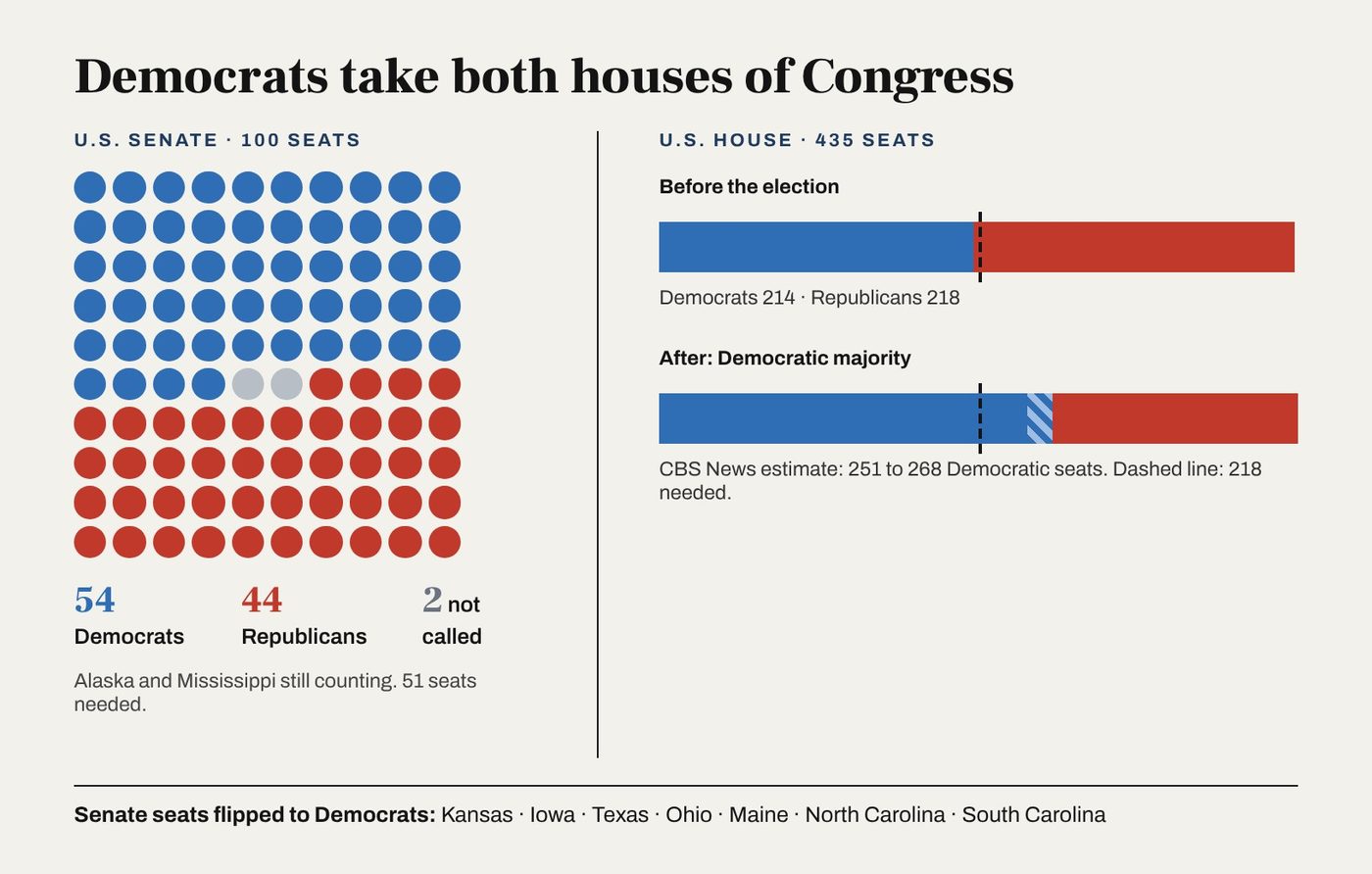
In the House, Republicans held 218 seats to the Democrats’ 214 going in, so Democrats needed a net gain of only three. They passed that mark easily. By the afternoon of Nov. 5 CNN projected the party would hold at least 250 seats, its largest majority since 2008. Rep. Hakeem Jeffries of Brooklyn, who won reelection, is in line to become Speaker.
Why voters moved
Exit polls pointed to the economy. Eighty-nine percent of voters told CBS News that the cost of living was a major or crucial factor in their vote. The President’s approval rating in early exit polls stood at 38 percent, historically low for a midterm. Vice President JD Vance blamed the war with Iran for the Republican losses.
Republicans promised to fight back. Senate Majority Leader John Thune said his party would not stand idly by as Democrats try to undo its work. Jeffries said the new majority would use its power to check the administration.
What changes
Control of both houses gives Democrats the power to block legislation, open investigations and shape spending bills for the next two years. Markets reacted quickly, jumping on Nov. 4 before giving the gains back on Nov. 5.
A Democratic Congress may also try to restrain the war against Iran that began in February, and several newly elected members are sharp critics of Israel. That has raised concern in parts of the Jewish community, a subject we look at later in this issue.
About two dozen House races were still uncalled on Nov. 5, and final totals may take days.
Around the country
Florida: Republican Byron Donalds defeated Democrat David Jolly, 50.0 to 48.7 percent, becoming the state’s first Black governor and extending the GOP’s 28-year hold on the office.
Texas: Democrat James Talarico won a U.S. Senate seat, the first Democrat to do so in Texas since 1988. Democrat Gina Hinojosa won the governor’s race.
Maine: Republican Sen. Susan Collins is projected to lose to Democrat Troy Jackson.