
About two-thirds of Jewish voters chose Democrats on Nov. 3. NBC News and CNN exit polls both put the figure at 68 percent, down from roughly three-quarters in 2024. Jews made up about 3 percent of the electorate.
Orthodox voters remain the outlier. A 2024 survey found 74 percent of Orthodox voters backing Trump, and the community’s concerns rarely line up neatly with either party: chinuch, safety, religious freedom, and the cost of keeping a large family afloat.
That diversity is something communal askanim insist on. As one Agudath Israel representative put it, Orthodox voters are not party-bound, and are politically sophisticated and pragmatic. It is not unusual for the same neighborhood to go strongly one way at the top of the ticket and back local officials of the other party who they felt represented their interests.
Safety: a concern that crosses every line
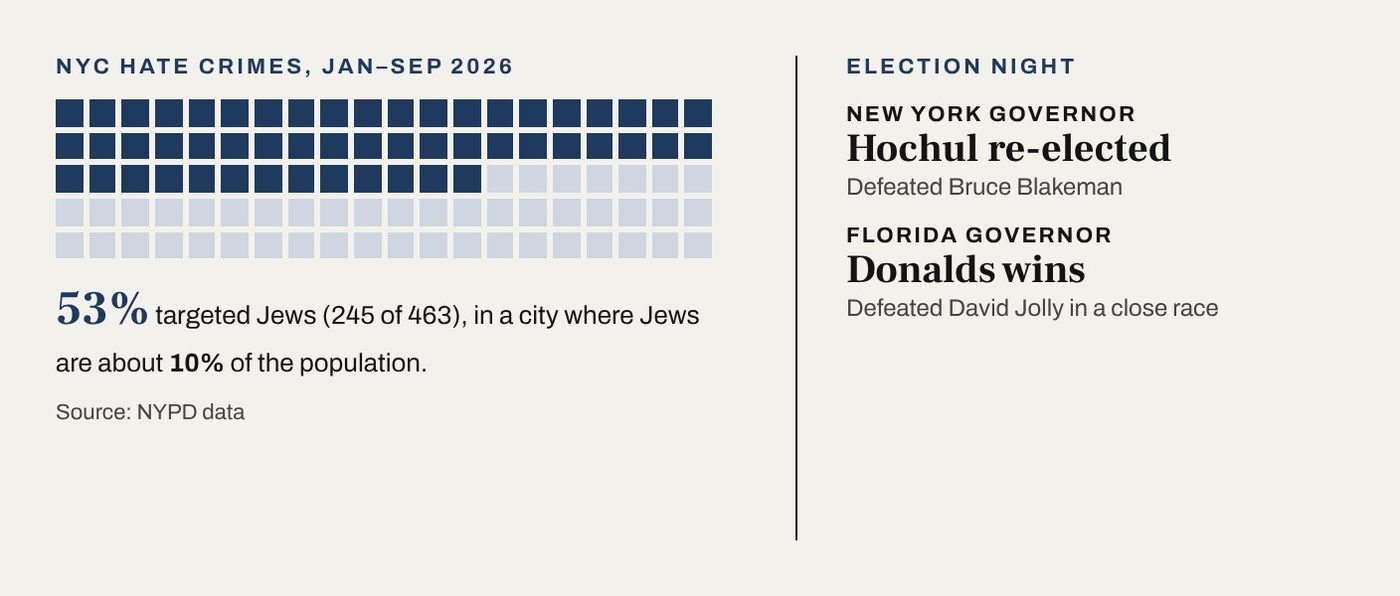
If one worry united voters across every community, it was the safety of Yidden who are easily recognized on the street. The numbers behind that worry are stark. According to NYPD data, Jewish New Yorkers were the victims in 245 of the 463 confirmed hate crimes in the city during the first nine months of 2026, or 53 percent, in a city where Jews make up roughly a tenth of the population. The pattern is not new: of 576 hate incidents recorded in 2025, 330 were antisemitic. Police Commissioner Jessica Tisch has called antisemitism the most persistent hate threat the city faces.
Those most exposed are often the most visible. The ADL has noted that more than half of the anti-Jewish physical assaults it recorded in New York City in 2024 targeted Orthodox Jews. Leaders across the political spectrum have acknowledged the problem. Mayor Zohran Mamdani called it “unacceptable” that Jewish New Yorkers make up a minority of the population yet the majority of hate-crime victims, and said his administration was working to address it. Even as overall crime fell, many Jewish New Yorkers said they still felt unsafe. In national surveys, antisemitism ranked among the top three issues for Jewish voters, alongside the cost of living and the future of democracy.
Israel on the ballot
For many Jewish voters, unease over Israel hung over this election. In Michigan, Democrat Abdul El-Sayed won a Senate seat despite deep concern in the Jewish community over his positions on Israel and antisemitism. A poll of Jewish early voters there found him running 21 points behind his party’s candidate for governor.
Behind many local conversations was a larger one. The Middle East saw a year of conflict, including a regional war that began in February and a series of fragile ceasefires. For countless families, this was not an abstract news story. Brothers, sisters, children and talmidim live in Eretz Yisroel, and tefillos for their safety were said in shuls and batei medrash across the country. For many, these worries sat quietly beside the practical business of choosing a ballot.
The common thread
Walk the streets of any of these communities and the same concerns surface: the safety of those who wear their Yiddishkeit openly, the freedom to run yeshivos as the community sees fit, the price of tuition and groceries, and a quiet hope for peace for Yidden wherever they live. Where neighbors differed was on who could best deliver, and that was the subject of many a Shabbos table.