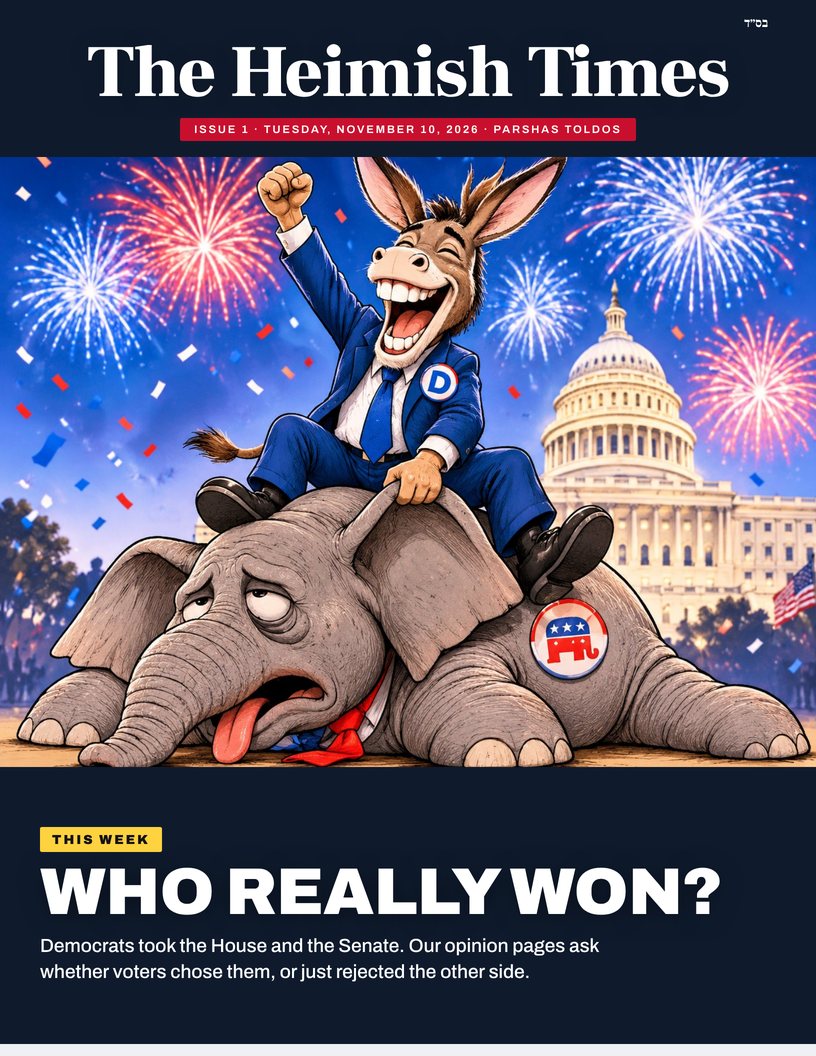
The headlines are predictable: Democrats swept Congress. A blue wave. A historic comeback. A mandate for change.
But beneath the celebratory speeches and victory-night declarations lies a more uncomfortable truth for both parties: Democrats may have won the election, but they did not necessarily win the hearts of the American people. Republicans lost them.
There is a difference—and it matters.
The election was not necessarily a sudden conversion to the Democratic platform. It was a verdict on the party that held power. Voters were frustrated, angry, and tired of what they were seeing. The economy was not delivering the relief many Americans had expected. The cost of living remained a daily concern. The war with Iran and its impact on prices added another layer of anxiety. And President Trump’s approval ratings had become a burden on Republican candidates across the country.
In the end, voters had an opportunity to send a message. They sent it loudly.
But a message against one party should not automatically be interpreted as enthusiasm for the other.
A Vote Against the Status Quo
Midterm elections have long served as a referendum on the party occupying the White House. The president’s party often loses seats, sometimes dramatically. Voters who feel ignored or disappointed use the ballot box to express their frustration.
This time, the Republican losses were extraordinary. Democrats made gains not only in traditional battlegrounds, but also in states and districts that had recently seemed safely Republican.
That tells us something important: Republican candidates were unable to separate themselves from the national mood.
President Trump urged voters to treat the election as a referendum on his leadership. In a sense, they did exactly that. The problem for Republicans was that the referendum did not go their way.
The election was less about voters embracing a new political philosophy than about voters rejecting the direction in which the country was moving.
When families are worried about grocery bills, gasoline, housing, healthcare, and their financial future, political slogans lose their power. Voters want results. They want to feel that their leaders understand the pressures of ordinary life.
Republicans had promised improvement. Many voters did not feel they had received it.
Where Was the Republican Motivation?
Perhaps the most striking part of the election was not simply how many Democrats turned out. It was how many Republicans failed to deliver the turnout their party needed.
A party can have a large base, a popular movement, and a powerful national leader—and still lose if its supporters become complacent.
Some Republican voters may have assumed that their party’s control of Washington was secure. Others may have been disappointed enough to stay home. Still others may have supported Trump in 2024 but felt less enthusiastic about voting Republican two years later.
That is the danger of governing: the excitement of winning eventually gives way to the responsibility of delivering.
The Republican coalition that brought Trump back to the White House was not necessarily a permanent alliance. It was made up of voters with different priorities—working-class families, conservatives, independents, business owners, and people who simply wanted change.
Those voters do not all have unlimited patience.
When a coalition is united by expectations rather than results, disappointment can quickly become disunity.
Democrats Benefited From the Anger
Democrats deserve credit for recognizing the political opportunity. They focused heavily on affordability and the economy, issues that directly affect households. They also benefited from voters who were unhappy with the president and his party.
But winning an election by benefiting from anger is not the same as winning an election by inspiring confidence.
The Democratic victory does not erase the party’s own challenges. It does not mean every voter suddenly agrees with its positions on immigration, social issues, taxes, or government spending. Nor does it mean that the country has moved decisively to the left.
In fact, the results may reflect something much simpler: millions of Americans wanted to change the people in charge.
That distinction will become important when Democrats begin governing.
If they interpret the results as permission to pursue every item on their ideological wish list, they may discover that the coalition that delivered victory is far less united than it appears. Voters who wanted lower prices and greater accountability may not necessarily want a sweeping transformation of American society.
A protest vote is not a blank check.
The Republican Party Has a Much Bigger Problem
For Republicans, the election should be a wake-up call.
It is not enough to blame historical midterm trends, unfavorable circumstances, or Democratic enthusiasm. Those factors may explain part of the result, but they do not excuse it.
The party must ask difficult questions.
Did it lose touch with the voters who helped it win in 2024? Did it spend too much time celebrating political victories and too little time addressing everyday concerns? Did its candidates become too closely tied to a national message that was not working in their own states?
And perhaps most importantly: did Republican voters themselves lose motivation?
A party cannot expect its supporters to turn out indefinitely based on loyalty alone. Enthusiasm must be renewed. Trust must be earned. Promises must be translated into tangible improvements.
The Republican Party now faces a serious challenge: rebuilding a coalition that appears to have been held together by hope, frustration, and the promise of change—but that has become increasingly vulnerable to disappointment.
The Real Lesson
The most important lesson of the 2026 midterms may be that American voters are not permanently loyal to either party.
They can swing dramatically when they feel that the party in power has failed them. They can vote for one party in a presidential election and punish it two years later. They can support a candidate without embracing the candidate’s entire platform.
This was not necessarily a Democratic revolution.
It was a Republican reckoning.
Democrats will now have their opportunity to prove that they can do better. Republicans will have to decide whether they are willing to learn from the defeat—or whether they will simply blame everyone else.
And voters will be watching.
Because the same electorate that rejected Republicans last week may reject Democrats just as decisively if the promises of lower costs, better governance, and a more stable country remain unfulfilled.
The ballot box did not declare that Democrats are the answer. It declared that, for millions of voters, Republicans had become the problem.