
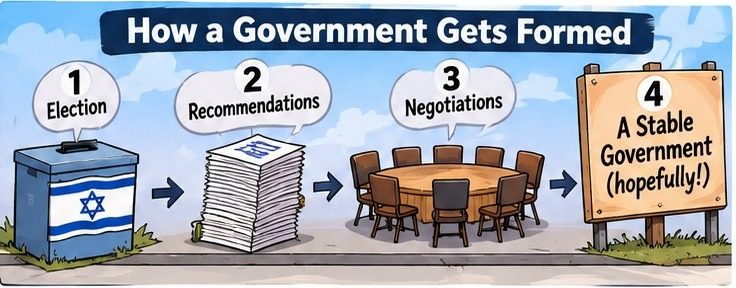
For readers following the news, the process is less mysterious than it can seem. It began last week.
After receiving the official results, the President of Israel meets with representatives of each faction. He asks two questions: whom do you recommend to form the government, and which coalition would you support or oppose? This round begins with the smaller factions and proceeds in ascending order of size. The President must assign the task within seven days of the official results, and he may hold a second round of consultations before he decides.
The person chosen does not have to be a party leader. Any Knesset member the President believes has the best chance can receive the mandate.
Whoever receives the first mandate has 28 days to form a government, and the President may extend that by another 14. If the effort falls short, the President can turn to another Knesset member. If that fails too, a majority of the Knesset has 21 days to agree on a candidate of its own.
And if no one succeeds? Israel heads to another election. That is an outcome every faction, from every part of the spectrum, says it hopes to avoid.
The timeline at a glance
Wednesday and Thursday, November 4–5: the President received the official results and heard the factions’ recommendations.
By November 11: the President names the candidate who receives the mandate.
Day 28: the deadline to present a government, unless the President grants an extension.
Day 42: the final deadline with the full 14-day extension.
After that: a second candidate, then 21 days for the Knesset, and if all else fails, new elections.