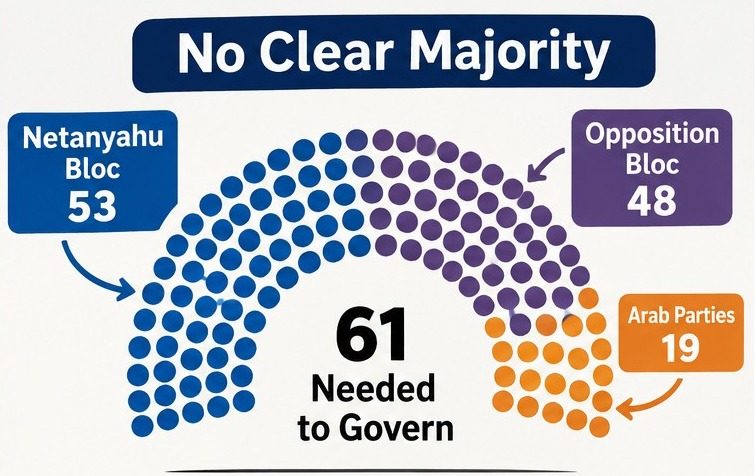
Israel’s October 27 election left no one with a clear path to a government. Likud finished as the largest party with 27 mandates. The Netanyahu bloc holds 53 seats, the opposition bloc 48, and the Arab parties 19. Sixty-one are needed to govern. Turnout reached nearly 78 percent, more than seven points higher than last time.
President Isaac Herzog received the official results on Nov. 4 and spent two days hearing the parties’ recommendations. Religious Zionism, Shas, Otzma Yehudit and Likud recommended Prime Minister Benjamin Netanyahu. Yisrael Beytenu, the Democrats, B’Yachad, Ra’am, the Joint List and Eisenkot’s own Yashar list recommended Gadi Eisenkot.
The final count: 67 recommendations for Eisenkot, a majority of the Knesset, and 46 for Netanyahu. Herzog is expected to give Eisenkot the first mandate. He has until November 11 to decide.
UTJ’s decision
United Torah Judaism, with seven seats, told the President on the morning of Nov. 5 that it would not recommend either candidate, saying it is not committed to either bloc. On Nov. 4 its Degel HaTorah faction, following the guidance of HaGaon HaRav Dov Landau, had announced it would not recommend anyone.
The decision reflects a deep rift with Netanyahu over the outgoing coalition’s failure to pass a law protecting the status of bnei yeshivah. In a call with party chairman Rabbi Yaakov Asher on Nov. 3, Netanyahu reaffirmed his commitment to completing the draft law. Party officials made clear that words alone were no longer enough.
Shas took the other road and recommended Netanyahu, after he publicly backed its chairman, Rabbi Aryeh Deri.
Recommendations are not a coalition
Sixty-seven recommendations do not make a government. Nineteen of Eisenkot’s come from the Arab parties, and several of his Jewish partners have ruled out sitting in a coalition with them. The Joint List said it was prepared to support a government from outside the coalition.
Whoever receives the mandate will have 28 days to form a government, with a possible 14-day extension. With no side holding a working majority, attention has turned from the ballot box to the negotiating table, where small factions may carry outsized weight.